How to Plan Carton Labels, SSCCs, and ASNs for Bulk Yard Sign Deliveries


These problems are especially important for retailers, franchise groups, distributors, resellers, national campaigns, and companies using third-party logistics warehouses.
A warehouse-ready delivery plan should connect every yard sign SKU to the correct cartons, pallets, purchase order, shipment data, and receiving destination.
Quick answer: Before placing a bulk yard sign order, send the supplier a current routing guide that defines carton-label data, barcode format, pallet-label requirements, SSCC ownership, ASN format and timing, label placement, mixed-carton rules, delivery appointments, and receiving tolerances. Test the complete label and ASN workflow before the first large shipment.
Why Correct Yard Signs Can Still Be Rejected
Distribution centers receive data as well as physical products.
A shipment may contain correctly printed yard signs but still create receiving problems when:
- The purchase order number is missing
- The supplier SKU does not match the buyer’s SKU
- The carton quantity differs from the packing list
- The pallet quantity differs from the ASN
- A barcode cannot be scanned
- The barcode contains different data from the readable text
- The label is covered by stretch film or a pallet strap
- Mixed cartons are not identified
- The wrong label is applied to a carton
- The ASN is transmitted after the shipment arrives
- The carrier arrives without a required delivery appointment
These errors may result in unloading delays, manual receiving, relabeling, storage charges, refused deliveries, compliance deductions, or retailer chargebacks.
The supplier should therefore receive the buyer’s warehouse requirements before quotation—not after production has been completed.
Start with the Buyer’s Routing Guide
A routing guide explains how a supplier should prepare, identify, document, book, and deliver freight to the buyer or its third-party warehouse.
The routing guide may define:
- Approved carriers
- Required shipping service
- Carton dimensions and weight limits
- Pallet type and dimensions
- Maximum pallet height and weight
- Carton-label format
- Pallet-label format
- Barcode symbology
- SSCC requirements
- ASN transmission method
- ASN submission deadline
- Delivery appointment process
- Required shipping documents
- Chargeback or noncompliance rules
The buyer should send the latest routing guide and confirm which requirements apply to the specific yard sign order.
A supplier should not assume that the requirements used for one customer or warehouse will be accepted by another.
Buyer note: Label printing, barcode testing, ASN setup, portal access, pallet configuration, and delivery appointments may affect both price and lead time. Include these requirements in the request for quotation.
Separate Product, Carton, and Pallet Identification
Different levels of the shipment serve different operational purposes.
| Identification Level | Purpose | Possible Information |
|---|---|---|
| Product or SKU | Identifies the yard sign design or ordering unit. | SKU, description, dimensions, artwork revision, and printing sides. |
| Carton | Identifies a case and the products packed inside it. | Purchase order, SKU, carton quantity, carton sequence, destination, and mixed-carton status. |
| Logistics unit or pallet | Identifies a handling unit that moves through the supply chain. | SSCC, ship-to location, purchase order, shipment number, and carrier information. |
Do not use one number for every identification level unless the buyer’s receiving system specifically requires that structure.
The buyer’s SKU should remain consistent across the purchase order, artwork register, carton label, packing list, ASN, warehouse system, and claim records.
Define the Carton-Label Requirements
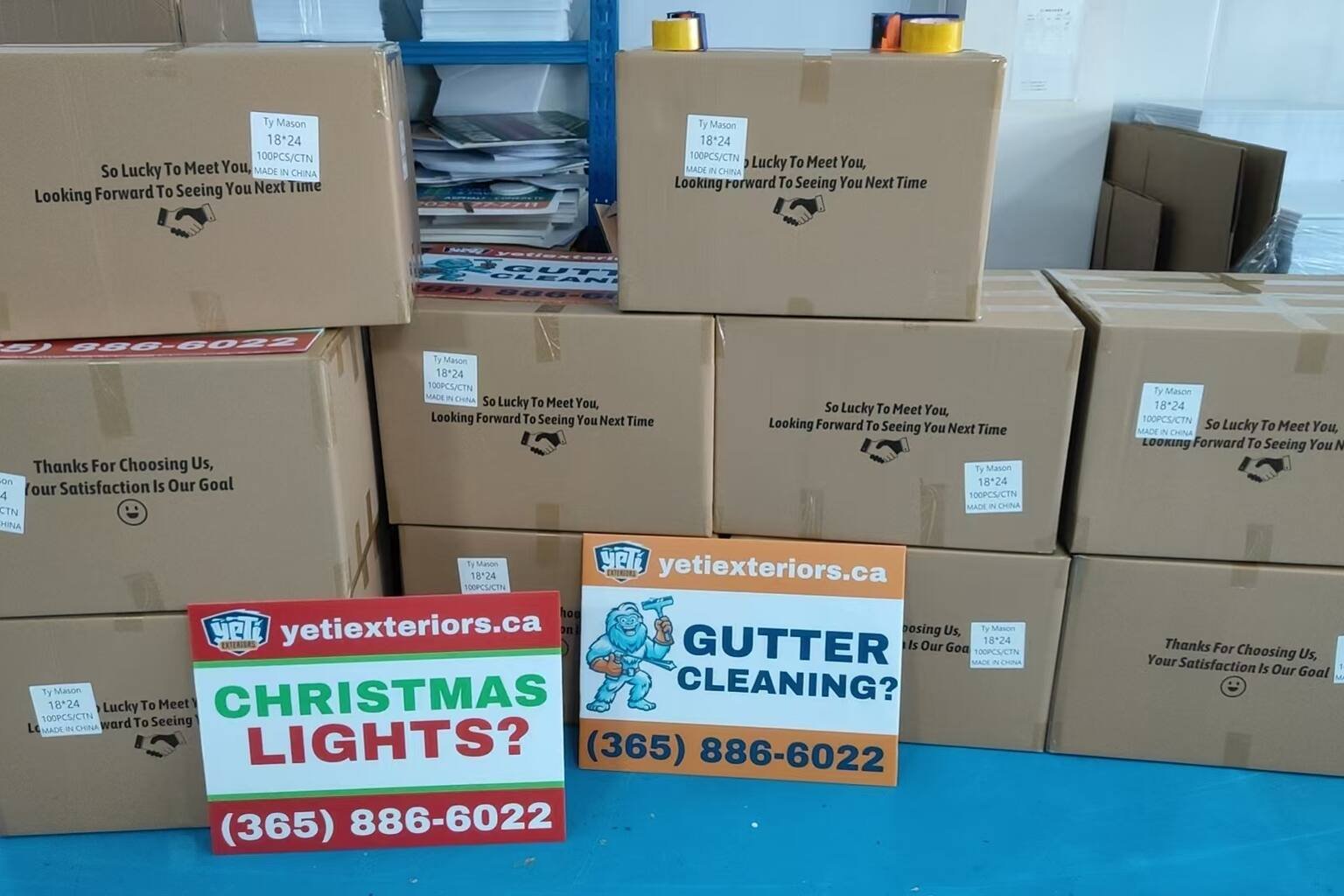
A practical yard sign carton label may include:
- Buyer or customer name
- Supplier name or supplier ID
- Ship-to location
- Purchase order number
- Buyer SKU
- Readable product description
- Artwork revision
- Finished sign size
- Quantity inside the carton
- Carton number
- Total number of cartons
- Campaign or location code
- Country of origin when required
- Human-readable barcode data
- Machine-readable barcode or 2D code
The exact content should follow the buyer’s routing guide and warehouse system.
Human-readable text should match the encoded barcode data. If a label says the carton contains SKU A but the barcode returns SKU B, the warehouse may receive the product incorrectly.
Use a Consistent Carton Numbering Method
Carton sequence numbers help the buyer verify whether the complete shipment has arrived.
A simple sequence may appear as:
CARTON 01 OF 24
For multi-location orders, a more useful carton identity may connect the carton to a destination and SKU:
ATLANTA / SKU-HS-018 / CARTON 01 OF 04
The packing list should show the carton range assigned to each SKU and destination.
When a buyer reports a shortage or incorrect product, carton-level identification makes it easier to determine whether the problem occurred during production, packing, consolidation, transportation, or receiving.
Define the Mixed-Carton Policy
A mixed carton contains more than one SKU, artwork version, sign size, or destination group.
Mixed cartons may improve packing efficiency when some products have low quantities. However, they can also create additional receiving and sorting work.
The buyer should state whether mixed cartons are:
- Prohibited
- Allowed only for the final carton
- Allowed for selected SKUs
- Allowed only with item-level labeling
- Allowed only with buyer approval
If mixed cartons are allowed, the carton should be marked clearly and the label should list the quantity of every SKU inside.
Important: Do not mix signs intended for different branches or final destinations merely to fill unused carton space unless the buyer has approved the arrangement. The small saving in packing space may create much larger sorting and redistribution costs.
Understand the Role of an SSCC
SSCC stands for Serial Shipping Container Code. It is used to identify a logistics unit, such as a pallet or another transport unit.
According to the GS1 Logistic Label Guideline, the SSCC is the mandatory element on a GS1 Logistics Label.
This does not mean every yard sign shipment automatically requires an SSCC. The buyer, retailer, 3PL, or distribution center determines whether the shipment must use GS1 logistics labels.
When required, the SSCC allows the physical logistics unit to be connected with electronic shipment information.
An SSCC should be:
- Unique for the identified logistics unit
- Created according to the applicable GS1 requirements
- Connected to the actual pallet contents
- Printed in the required barcode format
- Shown in human-readable form
- Included in the related ASN when required
- Recorded for shipment traceability
Confirm Who Creates the SSCC
The parties should confirm SSCC responsibility before label preparation begins.
Possible responsibilities include:
- The yard sign manufacturer creates the logistics unit and assigns the SSCC
- The exporter or consolidation warehouse creates the final pallet
- The buyer provides specific SSCC data
- A third-party logistics provider creates and identifies the unit
GS1 guidance generally assigns the SSCC using the GS1 Company Prefix of the party creating the logistics unit.
The buyer should not assume the supplier has an appropriate GS1 Company Prefix. This should be verified during vendor onboarding.
If the buyer supplies label data, the supplier should still check that each label is applied to the correct physical pallet.
Plan the Pallet-Label Content and Position
A pallet label may include:
- SSCC
- Buyer name
- Ship-to location
- Purchase order number
- Shipment number
- Supplier information
- SKU or mixed-pallet status
- Carton quantity
- Unit quantity
- Gross weight
- Carrier or routing information
The label should be placed where warehouse scanners and employees can access it.
When the routing guide requires labels on two adjacent sides, the supplier should apply both labels in the specified positions. Labels should not be hidden by:
- Stretch-film folds
- Pallet straps
- Corner boards
- Other shipping labels
- Document pouches
- Carton overhang
Additional carrier labels should not cover or create confusion with existing logistics labels.
Understand the Role of an ASN
ASN stands for Advance Shipping Notice. It is shipment information sent to the buyer or warehouse before the freight arrives.
An ASN may be transmitted through:
- Electronic Data Interchange
- GS1 XML messaging
- A retailer or 3PL portal
- Supplier-management software
- API integration
- A controlled spreadsheet or CSV template
- Another buyer-approved method
The exact format depends on the receiving organization.
An ASN may include:
- Buyer purchase order
- Supplier number
- Shipment number
- Ship date
- Expected arrival date
- Carrier
- Tracking or bill of lading number
- Ship-from and ship-to locations
- SKU quantities
- Carton count
- Pallet count
- SSCC for each logistics unit
- Contents connected to each SSCC
The ASN is not simply another name for a packing list. A packing list describes the physical shipment, while the ASN is transmitted in advance using the buyer’s required data method.
Make the ASN Match the Physical Shipment
The ASN should describe what was actually shipped—not what the supplier originally planned to ship.
Before sending the ASN, reconcile:
- Purchase order quantity
- Finished quantity
- Packed quantity
- Short-shipped quantity
- Approved overrun or underrun
- Carton count
- Pallet count
- SSCC list
- Carrier information
- Packing list
If the shipment changes after the ASN is transmitted, follow the buyer’s correction or cancellation procedure.
A warehouse may use the ASN to plan labor, dock space, storage, and receiving transactions. Incorrect data can therefore create problems before the truck or container arrives.
Test Labels and Barcodes Before Mass Printing
Do not wait until all cartons have been packed before discovering that the barcode format is incorrect.
Before mass printing labels, send a sample label to the buyer or 3PL for review.
The test should confirm:
- Required label dimensions
- Correct data fields
- Barcode symbology
- Application identifiers when applicable
- Correct check digit
- Barcode size
- Quiet zones
- Print contrast
- Human-readable data
- Label position
- Scan performance
- Performance through stretch film
Test labels using equipment or conditions that reasonably represent the destination warehouse.
A barcode that scans successfully on one phone application is not sufficient evidence that it meets the warehouse’s barcode-quality requirements.
Run a First-Shipment Compliance Test
The first shipment to a new warehouse should be treated as a controlled implementation.
Before the full order is released, review:
- Sample carton label
- Sample pallet label
- SSCC creation method
- Sample ASN
- Packing-list format
- Commercial-document format
- Delivery appointment process
- Warehouse contact information
- Exception and escalation contacts
After the first delivery, request feedback from the buyer or warehouse.
Useful questions include:
- Did all labels scan successfully?
- Did the ASN arrive before the shipment?
- Did the ASN match the received quantities?
- Were labels visible during unloading?
- Were any cartons manually relabeled?
- Were mixed cartons easy to identify?
- Were any compliance deductions issued?
- What should change before the repeat order?
Carton Label and ASN Checklist
| Control Point | Required Action | Evidence |
|---|---|---|
| Routing guide | Provide the current warehouse and carrier requirements before quotation. | Buyer-approved routing guide version. |
| Carton label | Confirm SKU, PO, quantity, carton sequence, destination, and barcode data. | Approved sample label. |
| Mixed cartons | Define whether mixing is prohibited or conditionally allowed. | Written packing rule and content list. |
| Pallet identification | Create unique logistics-unit identification where required. | SSCC record and pallet photographs. |
| ASN | Transmit accurate shipment information before arrival. | ASN confirmation or portal record. |
| Final reconciliation | Match PO, packed quantity, labels, packing list, ASN, and physical pallets. | Shipment-release record. |
How iYardSign Supports Warehouse-Ready Orders
iYardSign is a China-based custom yard sign manufacturer supporting bulk orders for distributors, franchise groups, multi-location companies, real estate organizations, home service brands, resellers, events, and promotional campaigns.
Depending on the order and receiving requirements, buyers can discuss:
- SKU-based packing schedules
- Design-based bundling
- Custom carton labels
- Carton sequence numbers
- Location-based packing
- Mixed-carton controls
- Pallet-label requirements
- SSCC coordination when applicable
- Packing-list preparation
- Shipment data preparation
- Pallet photographs
- Bulk delivery coordination
For a multi-destination program, review how to order yard signs for multiple locations or branches.
For physical packing considerations, review the bulk yard sign shipping and packaging guide.
Frequently Asked Questions
Does every yard sign carton need an SSCC?
No. An SSCC identifies a logistics unit, and the receiving organization determines whether that unit is a pallet, carton, or another handling unit. Follow the buyer’s routing guide and applicable GS1 requirements.
Is an ASN the same as a packing list?
No. A packing list describes the physical shipment. An ASN is transmitted before arrival using the buyer’s required electronic, portal, or structured-data method.
Who should create the SSCC?
The parties should define responsibility before production. GS1 guidance generally assigns the SSCC using the company prefix of the party creating the logistics unit.
Can several yard sign SKUs be packed in one carton?
Only when the buyer allows mixed cartons. The carton should be marked clearly and the label and packing list should identify every SKU and quantity inside.
When should the ASN be sent?
Follow the buyer’s required transmission window. The ASN should normally be accepted by the receiving system before the shipment arrives, and its data should match the freight actually shipped.
How can buyers reduce warehouse chargebacks?
Provide the current routing guide before quotation, approve sample labels, test barcode performance, validate the first ASN, reconcile all quantities before release, photograph finished pallets, and review first-shipment receiving results.
Planning a Warehouse or 3PL Yard Sign Delivery?
Send the purchase order, SKU list, artwork schedule, carton-label template, pallet requirements, routing guide, ASN instructions, warehouse address, delivery requirements, and required arrival date.
iYardSign can help organize design-based packing, carton identification, pallet information, shipping documents, and delivery coordination for your bulk yard sign order.