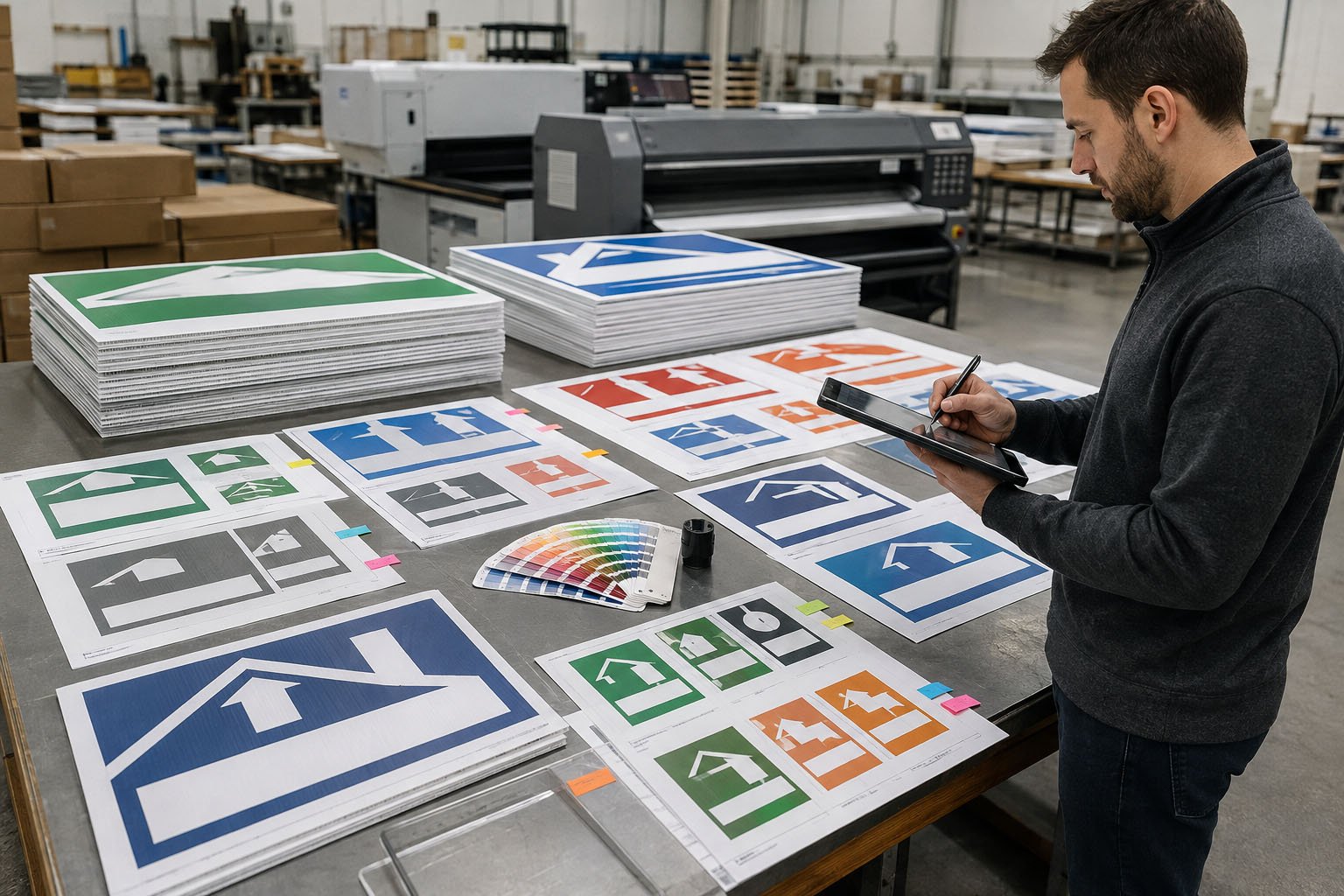
How to Build a Yard Sign Carton Labeling System for Bulk Orders

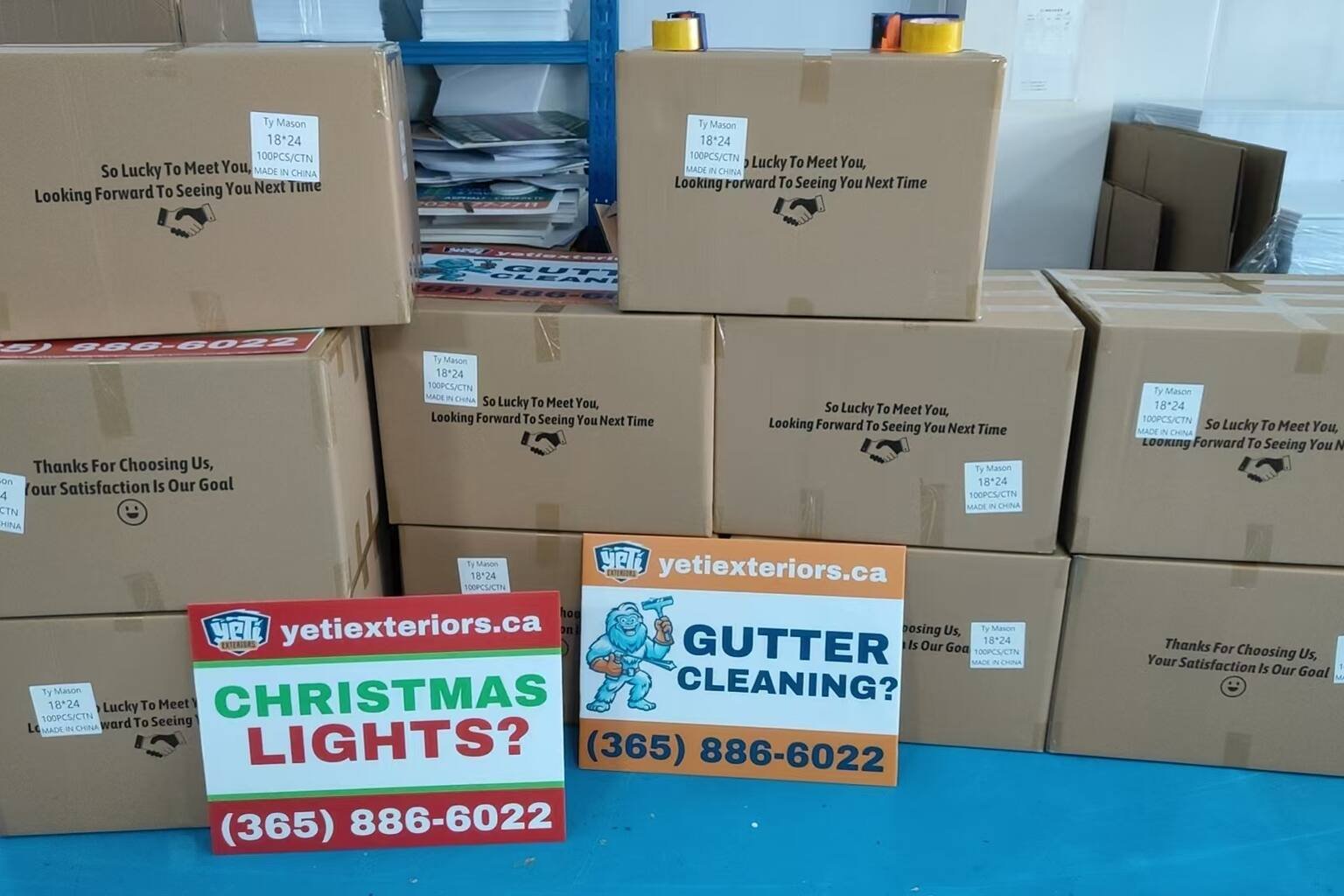
Quick answer: A reliable bulk yard sign labeling system should show the purchase order, design or SKU, carton number, quantity inside, sign size, accessory status, destination, and handling instructions. Use the same identifiers on the approved artwork list, carton labels, packing list, pallet summary, and shipment documents. Test the label format before packing begins.
Why Yard Sign Carton Labeling Matters in Bulk Orders
A single-design order shipped to one warehouse may be easy to identify. The risk increases when an order includes different customer names, phone numbers, colors, branches, campaign districts, or delivery locations.
Common receiving problems include:
- Different designs packed in similar unmarked cartons
- Carton counts that do not match the packing list
- H-stakes arriving without a clear link to the sign cartons
- One branch receiving another branch’s signs
- Warehouse staff opening cartons to identify the contents
- Partial deliveries that cannot be reconciled with the full order
- Damage or shortages that cannot be traced to a specific carton
These problems consume warehouse labor and delay distribution. They can also create customer-facing errors if a reseller ships the wrong phone number, campaign name, service area, or property information.
Good labeling does not replace an accurate packing process. It makes that process visible, traceable, and easier to verify.
Create One Identification Structure Before Production
The buyer and factory should agree on one naming structure before artwork approval. The identifiers should be short enough to print clearly but specific enough to prevent confusion.
A practical structure can include:
- Purchase order number: identifies the commercial order
- Design ID or SKU: identifies the exact artwork variation
- Location code: identifies a branch, region, customer, or campaign office
- Carton sequence: shows the carton number and total cartons in that group
- Revision: confirms which approved artwork version was printed
For example, PO2468-ATL-03-R2-C04/10 could mean purchase order 2468, Atlanta location, design 03, revision 2, carton 4 of 10. The exact format can vary, but every person handling the order should interpret it in the same way.
Avoid relying only on customer filenames such as final.pdf, new version.pdf, or approved latest 2.pdf. Those names are difficult to control and may be shortened or lost when files move between sales, design, production, and packing teams.
Buyer note: The design ID printed on the carton label should match the design ID on the final artwork approval sheet. If the two systems are different, the warehouse cannot reliably trace a carton back to the approved file.
What Information Should Appear on Each Carton?
The label should answer the main receiving questions without requiring the carton to be opened. The exact fields depend on the order, but a bulk yard sign carton normally benefits from the following information:
| Label Field | Purpose | Example |
|---|---|---|
| Buyer or brand | Separates orders stored or shipped together | NorthStar Signs |
| PO number | Connects the carton to purchasing records | PO-2468 |
| Design ID or SKU | Identifies the printed design | PRESSURE-ATL-03 |
| Revision | Confirms the approved artwork version | R2 |
| Product specification | Distinguishes size, side, or material | 18 × 24 in, double-sided |
| Quantity inside | Supports receiving and inventory checks | 50 signs |
| Carton sequence | Shows missing or duplicate cartons | 4 of 10 |
| Destination code | Supports branch or location allocation | ATL-WH2 |
| Accessory status | Clarifies whether stakes are included or separate | H-stakes in carton HS-04 |
The label may also include gross weight, carton dimensions, country of origin, handling symbols, pallet number, production date, or a buyer-provided barcode. Only include fields that remain accurate and useful throughout the shipment.
Use a Clear Visual Hierarchy on the Label
More information does not automatically create a better label. Warehouse staff should be able to recognize the most important fields from a normal working distance.
A practical label hierarchy is:
- Largest text: destination code or design ID
- Second level: carton sequence and quantity
- Supporting details: PO, size, revision, and accessory note
- Machine-readable field: barcode or QR code, if required
Use high-contrast black text on a white label. Avoid small type, decorative fonts, glossy surfaces that create glare, and handwritten changes that are difficult to audit. If color coding is used, repeat the meaning in text because colored labels may fade, print incorrectly, or be difficult for some workers to distinguish.
Apply labels to a consistent carton position. If the cartons may be stacked with one face hidden, place a duplicate label on a second visible side. Protect the label from tape seams, stretch film, abrasion, and moisture.
Connect Carton Labels to the Packing List
A carton label identifies one physical unit. The packing list explains the complete shipment. These records must use the same PO numbers, design IDs, carton sequences, quantities, and destination codes.
The packing list should show:
- Every carton number
- The design ID inside each carton
- Quantity per carton and total quantity per design
- Cartons assigned to each location
- H-stake carton numbers and quantities
- Any mixed carton and its exact contents
- Pallet assignment when cartons are palletized
Do not use a packing list that shows only a grand total. A total of 5,000 signs does not help a distributor determine whether design A has 800 pieces, design B has 1,200 pieces, and each branch received its correct allocation.
For orders with many designs, request the final carton-level packing list before departure. This allows the buyer to load the information into its warehouse system and prepare receiving instructions while the shipment is in transit.
Plan Labels for Multi-Design and Multi-Location Orders
Multi-location programs need an allocation plan before packing begins. The buyer should provide a destination matrix showing the required quantity of each design for each branch or customer.
There are three common packing methods:
- One design per carton: simplest to count and identify, but may create partially filled cartons
- One location per carton: useful for branch distribution when each carton contains a complete local kit
- Mixed cartons: can improve space use but require a detailed content label and internal separation
The best method depends on how the buyer will receive and distribute the signs. A print reseller shipping individual customer orders may prefer customer-specific cartons. A franchise warehouse may prefer location kits. A campaign organization may prefer cartons separated by district, field office, or installation team.
When mixed cartons are unavoidable, print every design ID and quantity on the outside label. Place an internal packing sheet at the top of the carton and use dividers or clearly separated bundles. Do not identify a mixed carton with the word “assorted” only.
Keep H-Stakes and Accessories Traceable
H-stakes are often packed separately because their weight and shape differ from corrugated plastic signs. A complete sign order can still be unusable if the correct number of stakes cannot be located.
The accessory record should identify:
- Stake type and size
- Quantity per accessory carton
- Total number of accessory cartons
- Related PO, design group, or destination
- Whether extra replacement stakes are included
If one branch receives 300 signs and 300 H-stakes, the label system should make that relationship clear. Use an accessory carton code such as ATL-HS-01/03 rather than a generic “metal parts” description.
After arrival, follow the storage practices in Bulk Yard Sign Storage: Prevent Damage and Missing H-Stakes to keep sign cartons and accessories organized.
When Should Buyers Use Barcodes or QR Codes?
Human-readable text should remain on every label even when a barcode is used. A barcode can speed up receiving and inventory updates, but it only works when the encoded data matches the buyer’s system.
Before adding barcodes, confirm:
- Which barcode format the buyer accepts
- What value should be encoded
- Whether the code identifies a SKU, carton, pallet, or shipment
- Required label size, quiet zone, print contrast, and placement
- Whether each carton needs a unique serial number
- How scan results will be tested before shipment
A QR code can link to an internal packing record, installation guide, or order page, but it should not be the only source of essential carton information. Internet access, permissions, or link maintenance may fail at the receiving location.
Buyers using standardized logistics labels can review the official identification and barcode guidance from GS1 barcode standards. The buyer should supply its exact coding requirements rather than asking the factory to guess.
Test the Yard Sign Carton Labeling System Before Packing
Approve one sample label before mass packing. This is similar to approving artwork before printing: a small mistake multiplied across hundreds of cartons becomes expensive to correct.
The sample-label review should verify:
- PO, SKU, revision, and destination fields match the approved order data.
- Text is readable at the required label size.
- Carton sequence format is clear.
- Barcode or QR code scans correctly, if used.
- Label adhesive and position suit the carton surface.
- The format remains readable under stretch film.
- The packing list can be reconciled with the sample label.
After approval, lock the data source and label template. If the buyer changes a location quantity or artwork revision, update the allocation list, packing instructions, and label data together.
Add Carton Verification to Final Inspection
Final inspection should check both the signs and the shipping identification. A high-quality printed product can still create a claim if the wrong design is packed or the carton record is inaccurate.
A practical carton audit can include:
- Comparing selected labels with the carton contents
- Confirming quantities in sampled cartons
- Checking the carton sequence for missing numbers
- Matching sign cartons with H-stake cartons
- Scanning machine-readable codes
- Comparing pallet totals with the packing list
- Photographing labels and completed pallets before loading
Record any repacked or corrected carton. Do not cover an incorrect label with another label unless the old information is completely removed or permanently obscured. Two visible labels can cause the wrong one to be scanned or followed.
Prepare the Receiving Team Before Arrival
Send the carton-level packing list, pallet summary, and expected shipment count to the receiving warehouse before delivery. The receiving team should know which fields to check and what to do when a discrepancy appears.
At arrival, the buyer should:
- Count pallets and cartons before breaking down the shipment.
- Check visible carton numbers against the packing list.
- Photograph external damage before moving affected cartons.
- Separate cartons by design or destination code.
- Scan labels or record receipt in the inventory system.
- Report missing, duplicate, damaged, or incorrect cartons by number.
Specific carton identification creates better evidence than a general statement such as “some signs are missing.” It helps the buyer, carrier, and supplier determine where the discrepancy occurred and what quantity is affected.
Bulk Yard Sign Carton Labeling Checklist
Before approving shipment, confirm:
- One PO and design-ID structure is used across all documents
- Every carton shows its contents and quantity
- Carton sequences are complete and nonduplicated
- Destination or branch codes match the allocation plan
- Mixed cartons list every design and quantity
- H-stake cartons are linked to the correct order or destination
- Barcodes or QR codes have been test-scanned
- Labels are readable after pallet wrapping
- The carton-level packing list matches the physical shipment
- Receiving staff have the final records before delivery
Important: Do not wait until the order is already packed to decide how cartons should be identified. Destination allocation, carton sequence, mixed-carton rules, accessory tracking, and barcode requirements must be confirmed before packing starts.
How iYardSign Supports Organized Bulk Packing
iYardSign manufactures custom corrugated plastic yard signs for overseas B2B buyers, including printing companies, sign shops, distributors, resellers, campaign suppliers, franchise groups, and multi-location service businesses.
For qualified bulk projects, buyers can discuss:
- Design IDs and carton-label templates
- Quantity separation by SKU or location
- Carton sequence and pallet identification
- Separate tracking for H-stakes and accessories
- Buyer-supplied barcode or QR-code requirements
- Carton-level packing lists
- Pre-shipment packing and loading records
Send the purchase order, artwork list, quantity by design, destination matrix, packing preference, H-stake requirements, and label specification before production approval. For orders with urgent and standard delivery portions, coordinate the carton plan with the yard sign split-shipment plan so each shipment can be reconciled separately.
Frequently Asked Questions About Yard Sign Carton Labeling
Does every carton need a unique number?
Yes, a unique carton sequence is strongly recommended for bulk orders. It helps identify missing cartons, partial deliveries, damage, and discrepancies without opening the entire shipment.
Should different yard sign designs be packed together?
One design per carton is usually easier to receive and count. Mixed cartons may be appropriate for branch kits or small design quantities, but the outside label and internal packing sheet should list every design and quantity.
What if H-stakes ship in separate cartons?
Give each stake carton its own sequence and link it to the relevant PO, design group, or destination. The packing list should show both sign cartons and accessory cartons.
Can the factory create barcodes for the buyer?
The factory can print buyer-approved barcode data and formats, but the buyer should provide the required symbology, encoded values, label dimensions, placement, and testing rules. Barcode requirements vary between inventory systems and customers.
How large should a carton label be?
It should be large enough for the design ID, destination, quantity, and carton sequence to be read without moving or opening the carton. The correct size depends on the carton, viewing distance, number of fields, and barcode specification.
What records should be sent before delivery?
Send the final packing list, carton count, pallet count, destination allocation, accessory summary, and any barcode data file required by the receiving warehouse.
Planning a Multi-Design 500+ Piece Yard Sign Order?
Send your artwork list, quantity by design, sign specifications, H-stake requirements, destination allocation, packing preference, and delivery schedule.
iYardSign can review the production, carton identification, packing-list, pallet, and shipping requirements for your bulk custom yard sign project.