How Franchise Networks Can Prevent Yard Sign Order Mix-Ups

How Franchise Networks Can Prevent Yard Sign Order Mix-Ups
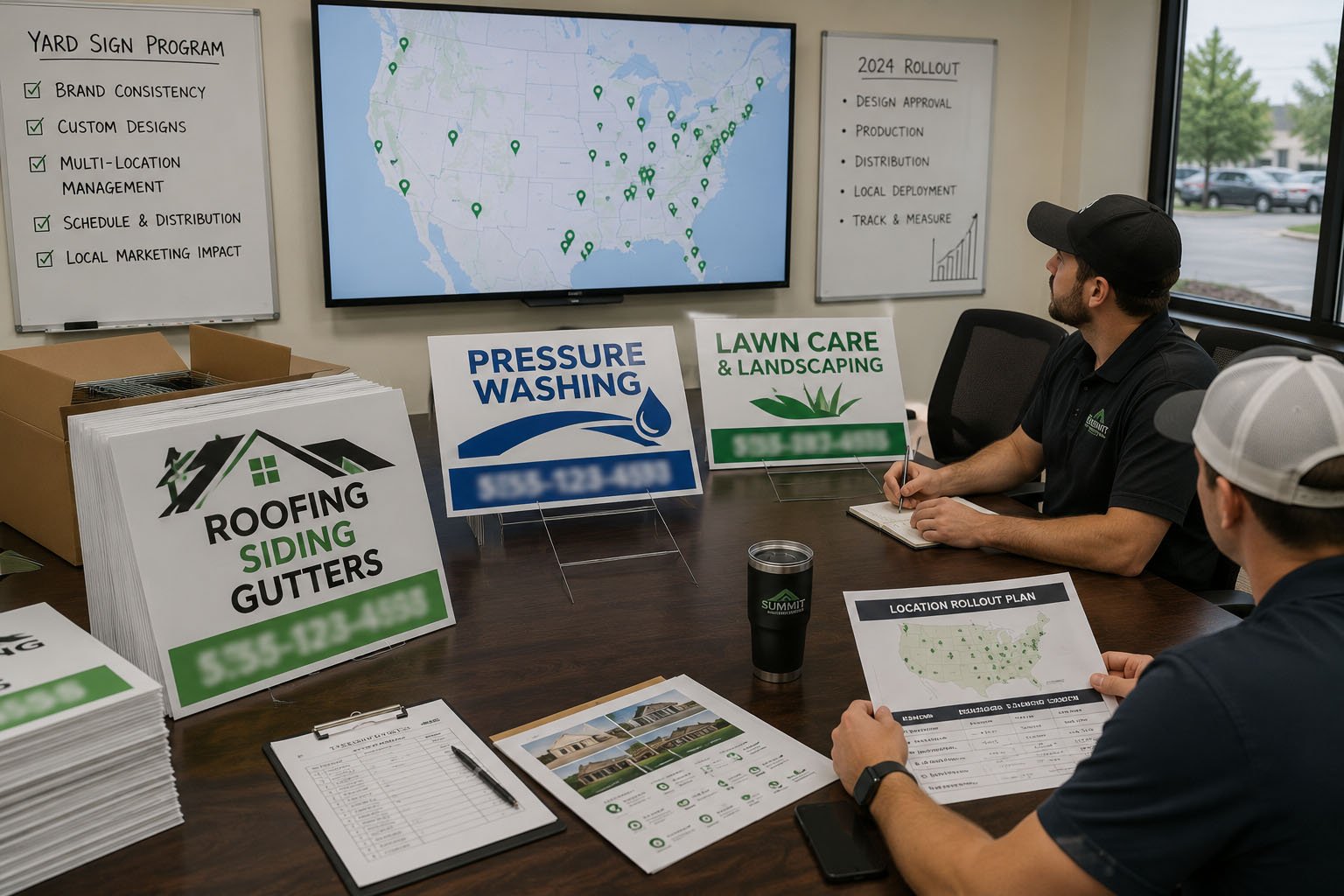
Franchise and dealer networks often need the same type of yard sign for many locations, but the details are rarely exactly the same. Each branch may have a different phone number, service area, address, manager, website, or promotional message.
This creates a practical purchasing problem. The signs may look similar, but the wrong phone number, wrong quantity, wrong carton, or outdated artwork can make an entire shipment difficult to use.
For a single-location business, an artwork mistake may affect one order. For a franchise network, the same mistake can be repeated across dozens of branches. The solution is not simply to order more carefully. It is to create a clear system for artwork versions, location data, approvals, packaging, and delivery.
This guide explains how franchise brands, dealer networks, agencies, and print distributors can reduce yard sign order mix-ups when managing multiple locations.
iYardSign supports bulk custom yard signs, corrugated plastic signs, H-stakes, multiple designs, artwork review, packaging coordination, and international production for multi-location buyers.
Quick Answer: How Can Franchise Networks Avoid Yard Sign Order Errors?
The most reliable approach is to separate the order into five controlled records:
- A master brand specification
- A location information sheet
- A numbered artwork version list
- A location-by-location quantity schedule
- A packaging and delivery plan
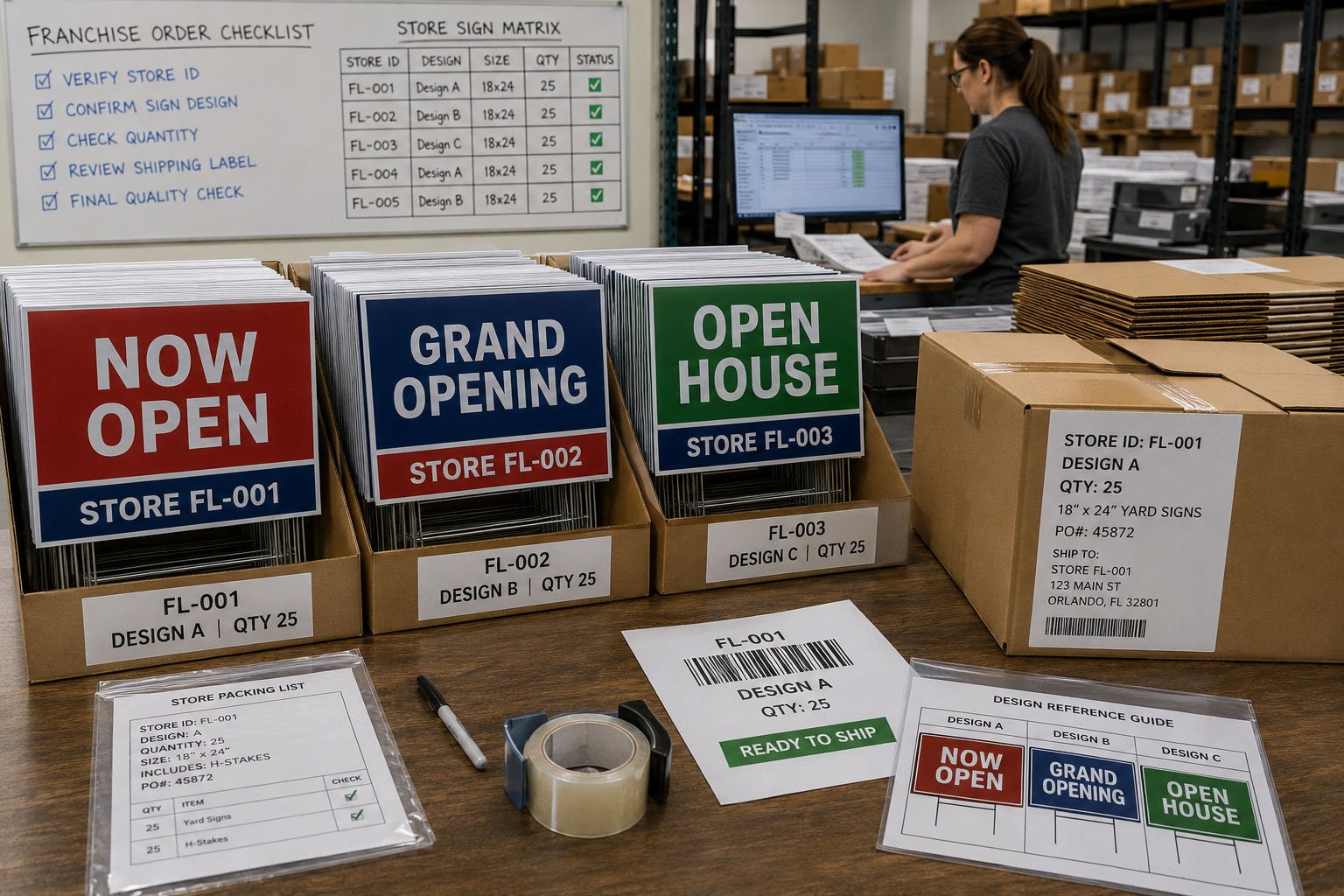
Every artwork file, quantity, carton label, and delivery address should be connected to a location code. This makes it easier for the buyer, factory, warehouse, and local branch to identify what belongs where.
One location code should identify the artwork, quantity, packaging label, invoice line, and delivery destination for that branch.
1. Separate Brand Rules from Local Information
A franchise network usually has two types of information:
Information That Should Stay Consistent
- Logo usage
- Brand colors
- Typography
- Minimum logo size
- Approved service descriptions
- Required disclaimers
- Standard sign dimensions
- Material and printing specifications
Information That May Change by Location
- Phone number
- Branch address
- Service area
- Local website or landing page
- QR code destination
- Dealer or franchise owner name
- Local promotion
- Quantity required by branch
If these two groups are mixed together in one informal design process, local teams may accidentally change the logo, color, or layout while trying to update a phone number.
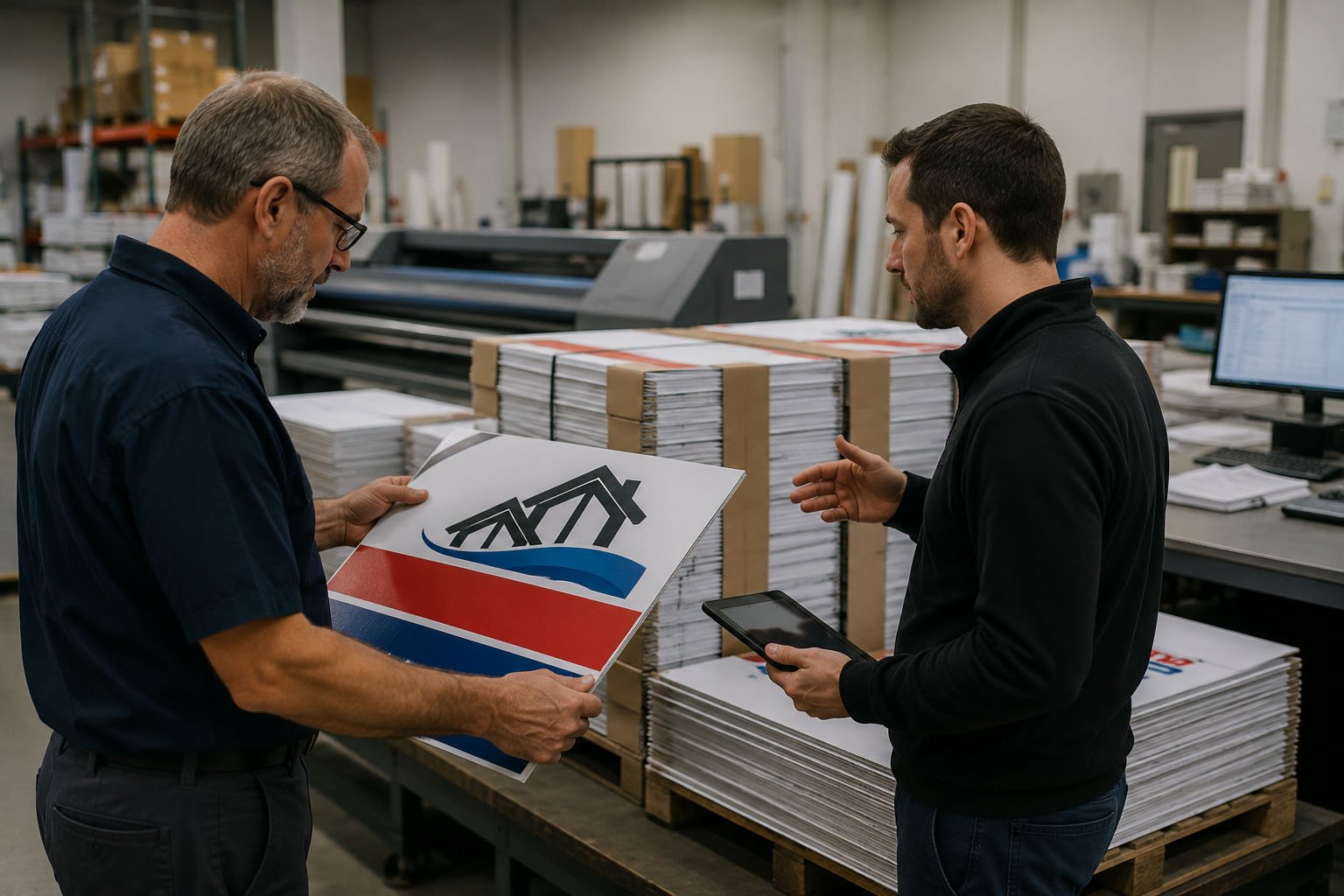
A better method is to create a master brand template and a separate local information table. The factory or design team can then apply approved local information without changing the controlled brand elements.
2. Assign a Location Code to Every Branch
Location names can be confusing. A branch may be known internally as “North,” “Branch 3,” or “Mike’s location,” while the official shipping label uses a full address.
Use a short location code for every branch, such as:
- TX-HOU-01
- CA-SD-02
- ON-TOR-03
- FL-MIA-04
The code should appear in:
- Artwork file names
- Purchase order lines
- Carton labels
- Internal inventory records
- Shipping documents
- Branch delivery instructions
For example, an artwork file could be named:
TX-HOU-01_18x24_RoofingSign_V03_APPROVED.pdf
This is much safer than using file names such as “final sign.pdf” or “Houston new sign.pdf,” especially when several people are uploading and downloading files.
3. Create One Location Data Sheet
The location data sheet should be the single source of truth for local information. It should be reviewed before artwork production begins.
| Field | Example |
|---|---|
| Location code | TX-HOU-01 |
| Branch name | Houston North |
| Phone number | Local branch phone |
| Website or QR destination | Location-specific landing page |
| Quantity | 250 signs |
| Delivery address | Approved branch or warehouse address |
Do not ask the factory to interpret information from several email threads, spreadsheets, and chat messages. Consolidate the final data before artwork and production approval.
Buyers can use the
yard sign quote information checklist
as a starting point when collecting complete requirements from each location.
4. Control Artwork Versions
Version control is one of the most important parts of a multi-location order. A franchise team may approve a design, then later update a phone number or QR code. If the old file remains in the production folder, the factory may receive conflicting instructions.
Use a simple version system:
- V01 for the first working version
- V02 for the next revision
- V03 for the approved revision
- APPROVED only after written confirmation
Avoid sending several files with names such as “final,” “final-new,” and “final-corrected.” The production team should receive one clearly identified file for each location and design.
The approval message should identify:
- Location code
- Artwork version
- Sign size
- Quantity
- Printing sides
- Approval person and date
For large networks, it is also useful to maintain an artwork register showing which locations have approved files and which are still waiting for local confirmation.
5. Separate Localized Designs from Standard Designs
Not every branch needs a completely different sign. Many franchise programs can use a standard design for most locations and create localized versions only where necessary.
A useful structure may include:
- One master brand design
- One standard contact version
- Location-specific phone number versions
- Special campaign versions
- Temporary event or promotion versions
This reduces unnecessary design work and makes production easier. It also helps the buyer understand which changes are essential and which changes are optional.
When several designs are produced together, confirm the quantity per design before accepting the quotation. The
multiple-design bulk order guide
can help organize artwork and quantities.
6. Build a Location-by-Location Quantity Schedule
A total quantity is not enough for a franchise order. The buyer should show how many signs belong to each branch, design, size, and packaging unit.
For example:
| Location Code | Design | Quantity | H-Stakes |
|---|---|---|---|
| TX-HOU-01 | Roofing V03 | 250 | 250 |
| CA-SD-02 | Roofing V02 | 150 | 150 |
| ON-TOR-03 | Standard V01 | 300 | 300 |
This schedule prevents a common error in which the total quantity is correct but the branch allocation is wrong.
7. Decide Whether to Ship to One Warehouse or Many Locations
A franchise network may choose between centralized delivery and direct shipment to individual branches.
Centralized Delivery
- One main receiving location
- More control over quality inspection
- Branches receive stock through an internal distribution process
- May reduce complexity for the factory
- Requires additional domestic handling after receipt
Direct Delivery to Branches
- Fewer internal redistribution steps
- Useful when branches need different designs or quantities
- Requires accurate delivery addresses
- Needs clear carton and shipment identification
- May require separate shipping quotations
The correct choice depends on order size, delivery locations, internal warehouse capability, and customer deadlines. The buyer should decide the shipping model before the factory finalizes the carton plan.
For multi-location purchasing, review the
multiple-location yard sign ordering guide
for additional planning considerations.
8. Use Carton Labels That Match the Branch Schedule
Carton labels should be designed for warehouse and branch employees, not only for the factory. A label that clearly connects the carton to a location can prevent the wrong signs from being sent to a customer or installed at the wrong property.
A useful label may include:
- Location code
- Design name and artwork version
- Sign size
- Quantity inside the carton
- H-stake quantity
- Carton number
- Destination address or destination code
- Order reference
If one location receives several cartons, use labels such as “Carton 1 of 3,” “Carton 2 of 3,” and “Carton 3 of 3.” This makes it easier to verify the delivery and identify a missing carton.
9. Confirm Every Localized Proof Before Mass Production
A master brand approval does not automatically approve every local version. Each location-specific phone number, QR code, web address, and service area should be checked before production.
A branch approval process should confirm:
- Correct branch name
- Correct phone number
- Correct website or QR destination
- Correct service area
- Correct logo and brand colors
- Correct sign size and quantity
- Correct delivery information
For a new brand design or a large campaign, request a physical sample before mass production. For a repeat order with unchanged artwork, a digital proof and documented approval may be sufficient, depending on the buyer’s quality requirements.
The
yard sign sample approval process
can help teams decide what should be reviewed before a large production run.
10. Keep a Reorder Record for Each Location
A franchise sign program becomes easier when every completed order creates a reusable record. The record should show what was produced, for whom, and under which approved specifications.
Keep:
- Approved artwork file
- Location data sheet
- Quantity by design
- Sign and stake specifications
- Packaging details
- Shipping information
- Inspection records
- Production date
- Reorder notes
When a branch needs more signs, the team can reorder from a verified record rather than rebuilding the design from memory. This reduces the chance of using an old phone number, old logo, or outdated QR code.
A well-maintained record also helps the buyer compare demand between locations and identify which branches need more frequent replenishment.
How iYardSign Supports Multi-Location Orders
iYardSign can work with franchise brands, dealer networks, agencies, distributors, and print businesses that need several custom yard sign designs in one production program.
When requesting a quotation, buyers should provide:
- Master brand specifications
- Location list and location codes
- Artwork files and versions
- Quantity for each location
- Sign size and material
- One-sided or double-sided printing
- H-stake requirements
- Packaging and labeling instructions
- Delivery model and destination details
For a long-term supply program, buyers can also review the
long-term yard sign supplier relationship guide
to improve repeat-order communication.
For a new multi-location request, visit the
iYardSign custom service
and prepare the location, artwork, quantity, and delivery information in advance.
Frequently Asked Questions
What is the biggest risk when ordering yard signs for many franchise locations?
The biggest risks are outdated localized artwork, incorrect branch quantities, mixed cartons, wrong delivery addresses, and missing accessories. A location code system and a written quantity schedule can reduce these problems.
Should every franchise location have a different yard sign design?
Not necessarily. Most networks can use one consistent brand template and change only the local information that is necessary, such as phone number, service area, address, or QR code destination.
How should a factory label cartons for multiple branches?
Carton labels should include the location code, design name, artwork version, quantity, carton number, and destination reference. The label system should match the buyer’s purchase order and location schedule.
Can several franchise yard sign designs be produced in one order?
Several designs can often be organized into one bulk production order, but the buyer should confirm quantity requirements per design, artwork approval status, packaging, and delivery allocation before production begins.
What information should a franchise buyer send to a China yard sign manufacturer?
Send the master brand guidelines, location list, artwork files, quantity by branch, sign specifications, H-stake requirements, packaging labels, delivery addresses, and any inspection requirements.
Managing Yard Signs for Multiple Locations?
Send iYardSign your brand specifications, location schedule, artwork versions, quantities, H-stake requirements, packaging details, and delivery plan. We can review the project for organized bulk production.