How to Prepare Artwork Files for Custom Yard Sign Printing

iYardSign is a China-based custom yard sign manufacturer supporting custom printed yard signs, corrugated plastic signs, H-stakes, artwork review, proof checking, OEM production, and international shipping support for US and Canada buyers.
Quick Answer: What Artwork File Is Best for Custom Yard Signs?
The best artwork files for custom yard sign printing are usually vector files or high-quality print-ready PDFs. Common accepted formats include AI, PDF, EPS, and sometimes high-resolution PNG, JPG, or PSD files if the resolution is suitable.
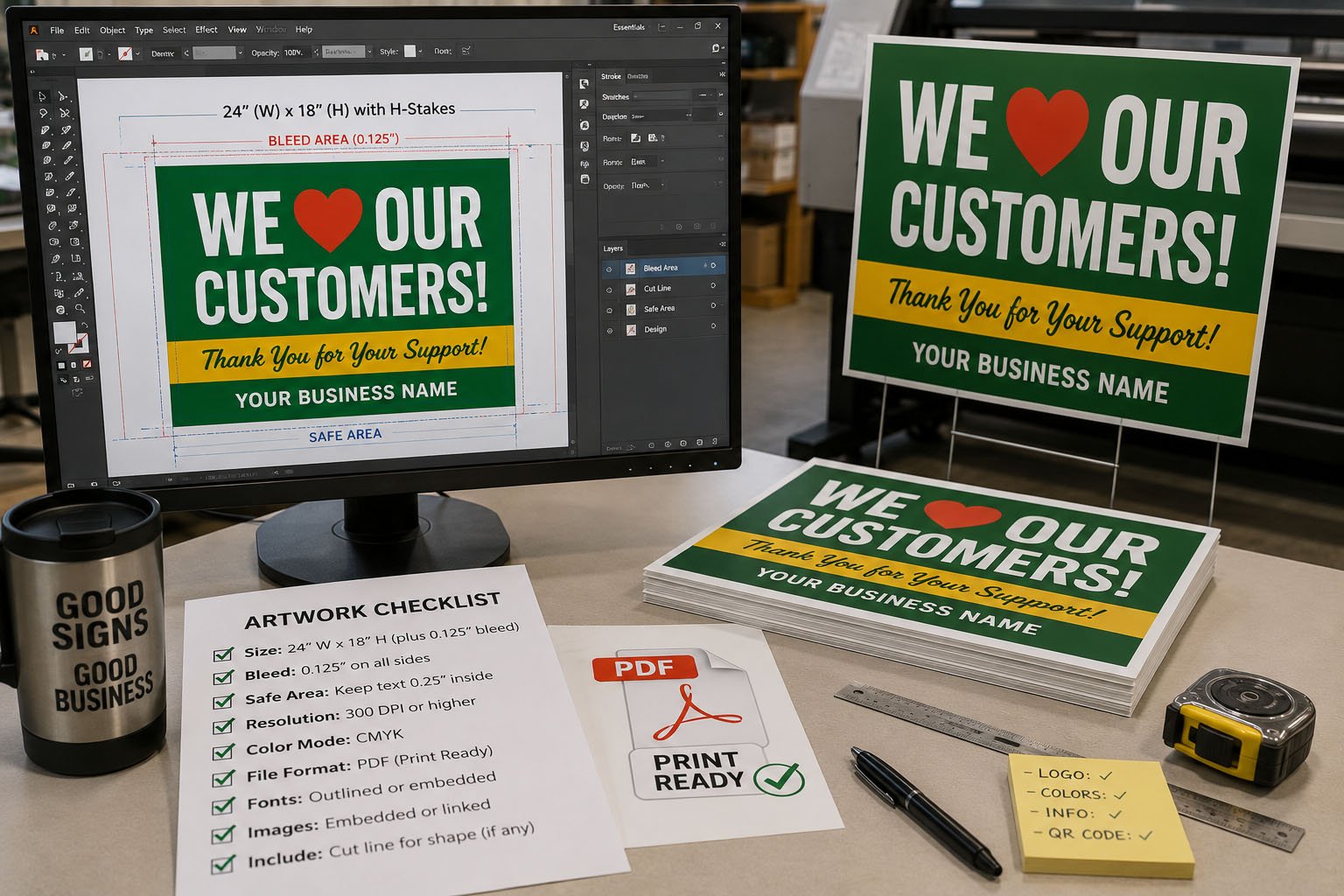
For the best result, the artwork should be prepared at the correct finished size, include bleed and safe margins, use high-resolution images, outline or embed fonts, and keep important text and QR codes readable from a practical viewing distance.
Why Artwork Preparation Matters for Yard Signs
Yard signs are usually viewed outdoors, often from several feet away or from a moving vehicle. This means the design must be clear, readable, and simple enough to understand quickly.
Artwork preparation matters because it affects:
- Print sharpness
- Text readability
- Logo quality
- Color expectations
- Bleed and edge trimming
- QR code scanning
- Production speed
- Reorder consistency
A professional-looking yard sign starts before printing. It starts with a clean file.
1. Use the Correct Finished Size
The artwork should be created at the final sign size. If the finished sign is 18×24 inches, the artwork should be prepared for that size, not a random social media image or screenshot.
Common yard sign sizes include:
- 18×24 inches
- 24×18 inches
- 24×36 inches
- Custom shape sizes
- Directional sign sizes
Buyers should also confirm orientation. A horizontal 24×18 inch sign and a vertical 18×24 inch sign are not the same from a design perspective.
Standard product options can be reviewed through custom yard signs.
2. Add Bleed When Required
Bleed is the extra artwork area that extends beyond the final trim size. It helps prevent white edges if the design background reaches the edge of the sign.
If the design has a full background color, image, or border, bleed is usually important. If the design has a white background and no edge-to-edge color, bleed may be less critical, but the supplier should still confirm the requirement.
Buyers should ask the supplier:
- How much bleed is required?
- Should the file include trim marks?
- Should the artwork be submitted at finished size plus bleed?
- Where should important content stay inside the safe area?
Bleed is a small file detail, but it can prevent visible trimming problems.
3. Keep Important Text Inside Safe Margins
Safe margins protect important information from being too close to the edge. Phone numbers, websites, QR codes, logos, and key messages should not sit right on the trim line.
Important elements to keep inside the safe area include:
- Company logo
- Phone number
- Website URL
- QR code
- Agent name or business name
- Main headline
- Directional arrows
Safe margins are especially important for real estate signs, contractor signs, and event signs because these signs often include contact information that must remain readable.
4. Use Large, Readable Text
Yard signs are not brochures. People do not stand close and read long paragraphs. They usually look at the sign quickly while walking, driving, or passing by.
For better readability, buyers should:
- Use short messages
- Make the main headline large
- Use strong contrast between text and background
- Avoid thin fonts for small text
- Keep phone numbers easy to read
- Avoid placing text over busy images
If the sign needs to generate calls or visits, the contact information should be one of the clearest parts of the design.
5. Outline or Embed Fonts
Missing fonts can change the appearance of a design. If the supplier opens the file without the correct font installed, the layout may shift or text may display incorrectly.
To avoid font problems, buyers should:
- Outline fonts before sending vector files
- Embed fonts in PDF files when possible
- Avoid using unusual fonts unless they are included properly
- Check that text spacing has not changed after exporting
For repeat orders, buyers should keep the final approved artwork file instead of recreating the design from an old screenshot.
6. Use High-Resolution Images and Logos
Low-resolution images may look acceptable on a screen but become blurry when printed. This is common when buyers use website images, screenshots, or copied social media graphics.
For better print quality, buyers should provide:
- Vector logos when possible
- High-resolution photos if photos are used
- Original design files instead of screenshots
- Clean QR codes with enough size and contrast
- Sharp icons and graphics
If the image looks blurry when enlarged on screen, it may also print poorly on a yard sign.
7. Test QR Codes Before Production
QR codes are useful for real estate signs, contractor signs, event signs, retail promotions, and local business marketing. But a QR code that does not scan properly can waste the purpose of the sign.
Before production, buyers should test:
- Whether the QR code scans from a phone
- Whether the link opens correctly
- Whether the QR code has enough contrast
- Whether the QR code is large enough
- Whether the QR code is too close to the edge
- Whether the destination page is mobile-friendly
For outdoor use, bigger and simpler is usually safer. A tiny QR code may scan in a PDF proof but fail in real use.
8. Prepare Separate Files for Multiple Designs
Bulk yard sign orders often include multiple designs. For example, a real estate team may have different agents. A contractor may have several service categories. An event organizer may need different directional signs.
To avoid confusion, buyers should:
- Name each file clearly
- Send a design quantity list
- Use the same size for designs in the same batch when possible
- Confirm which files are single-sided or double-sided
- State whether each design needs separate packaging
Example file names:
- Open-House-Arrow-Left-18×24-Double-Sided.pdf
- Roofing-Service-Sign-18×24-With-H-Stakes.pdf
- Event-Parking-24×18-Single-Sided.pdf
Clear file names reduce production mistakes.
9. Confirm Single-Sided or Double-Sided Artwork
If the sign is double-sided, buyers should confirm whether both sides use the same artwork or different artwork. This must be clear before production.
Double-sided artwork options include:
- Same artwork on both sides
- Different artwork on each side
- Arrow signs with left and right versions
- Front side with logo and back side with contact information
- Directional signs with different instructions on each side
If the artwork is different on each side, the files should be labeled clearly as front and back.
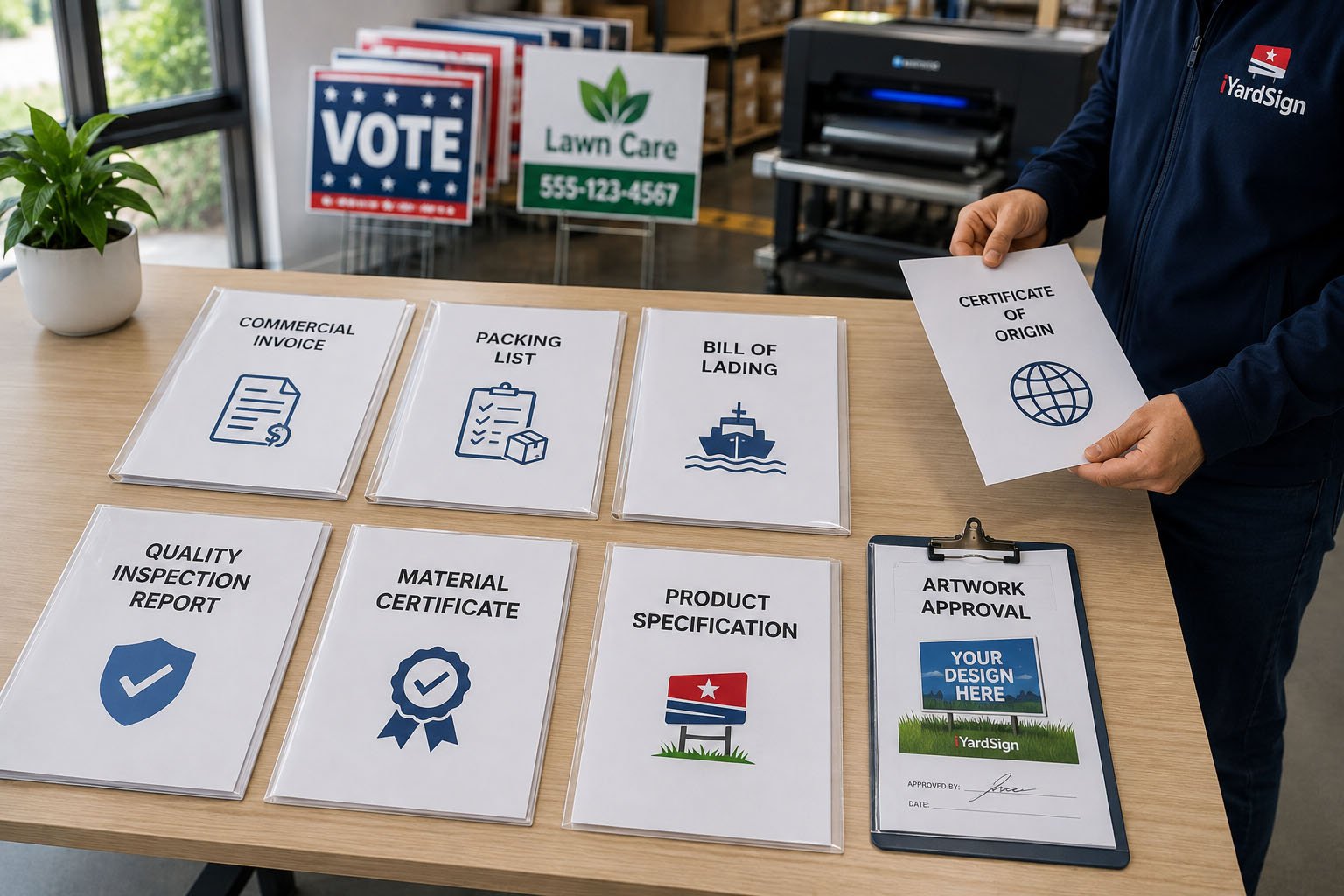
10. Approve the Final Proof Before Production
Before mass production starts, buyers should review and approve the final proof. This step is not only for the supplier. It protects the buyer as well.
Before approval, check:
- Correct size
- Correct design
- Correct spelling
- Correct phone number and website
- Correct logo
- Correct QR code
- Correct single-sided or double-sided setup
- Correct design quantity list
- Correct H-stake requirement
Once the proof is approved and mass production begins, changes may cause delays or extra cost.
Artwork File Checklist for Custom Yard Signs
| Artwork Item | Why It Matters | Buyer Check |
|---|---|---|
| Finished size | Prevents scaling and layout problems | Confirm 18×24, 24×18, or custom size |
| Bleed | Prevents white edges after trimming | Ask supplier for bleed requirement |
| Safe margin | Protects important text and logos | Keep key content away from edges |
| Fonts | Prevents missing or changed text | Outline or embed fonts |
| Image quality | Prevents blurry printing | Use vector or high-resolution files |
| QR code | Supports lead capture and tracking | Test scanning before approval |
How iYardSign Supports Artwork Review
iYardSign helps buyers review artwork before custom yard sign production. This can reduce file problems and help buyers prepare cleaner orders for bulk production.
iYardSign can support artwork review for:
- Bulk custom yard signs
- 18×24 inch corrugated plastic signs
- Yard signs with H-stakes
- Real estate signs
- Contractor and business signs
- Event and directional signs
- Multiple designs in one order
- OEM and repeat production orders
Buyers can explore product categories through custom printed sign products or contact the team through iYardSign’s contact page.
Need Help Reviewing Yard Sign Artwork?
Send your artwork file, size, quantity, design list, H-stake needs, and production requirements. iYardSign can help review the file before bulk custom yard sign printing.
Final Thoughts
A good yard sign starts with a good artwork file. Buyers can avoid many production problems by preparing the correct size, adding bleed when needed, keeping safe margins, outlining fonts, using high-quality images, testing QR codes, and approving the final proof carefully.
For bulk custom yard signs, clean artwork does more than improve print quality. It also saves time, reduces questions, and helps future reorders stay consistent.
For buyers looking for a factory-direct custom printed yard sign manufacturer, iYardSign can support artwork review, bulk yard sign production, H-stake coordination, packaging planning, and repeat custom sign orders for US and Canada markets.