Yard Sign Inventory Reorder Points: A Practical Guide

Yard Sign Inventory Reorder Points: A Practical Guide for Bulk Sellers
Running out of a popular yard sign design can delay customer orders, create urgent shipping costs, and send buyers to another supplier. Ordering too early, however, can tie up cash in slow-moving designs and occupy valuable warehouse space.
For print shops, distributors, brands, agencies, and ecommerce sellers, the important question is not simply “When should I order more yard signs?” The better question is:
At what inventory level should I place the next order so the new signs arrive before the current stock is exhausted?
This level is called the reorder point. A practical reorder point combines sales speed, production time, international shipping time, customs or delivery risk, seasonal demand, and a reasonable safety stock.
iYardSign supports bulk buyers with custom printed yard signs, corrugated plastic signs, H-stakes, multiple designs, packaging coordination, and international order planning.
Quick Answer: How Do You Calculate a Yard Sign Reorder Point?
A simple reorder point formula is:
Reorder Point = Average Sales During Supplier Lead Time + Safety Stock
For overseas bulk yard signs, supplier lead time should include more than factory production. It may include artwork confirmation, sample approval, production, packaging, export handling, shipping, customs processing, and final delivery.
For example, if a seller moves 500 signs per week, expects a total replenishment lead time of five weeks, and wants two weeks of safety stock:
500 signs × 5 weeks = 2,500 signs during lead time
500 signs × 2 weeks safety stock = 1,000 safety stock
Reorder point = 3,500 signs
When available inventory reaches approximately 3,500 signs, the seller should begin the next purchasing process rather than waiting until the warehouse is almost empty.
1. Measure Sales by Design, Not Only by Total Quantity
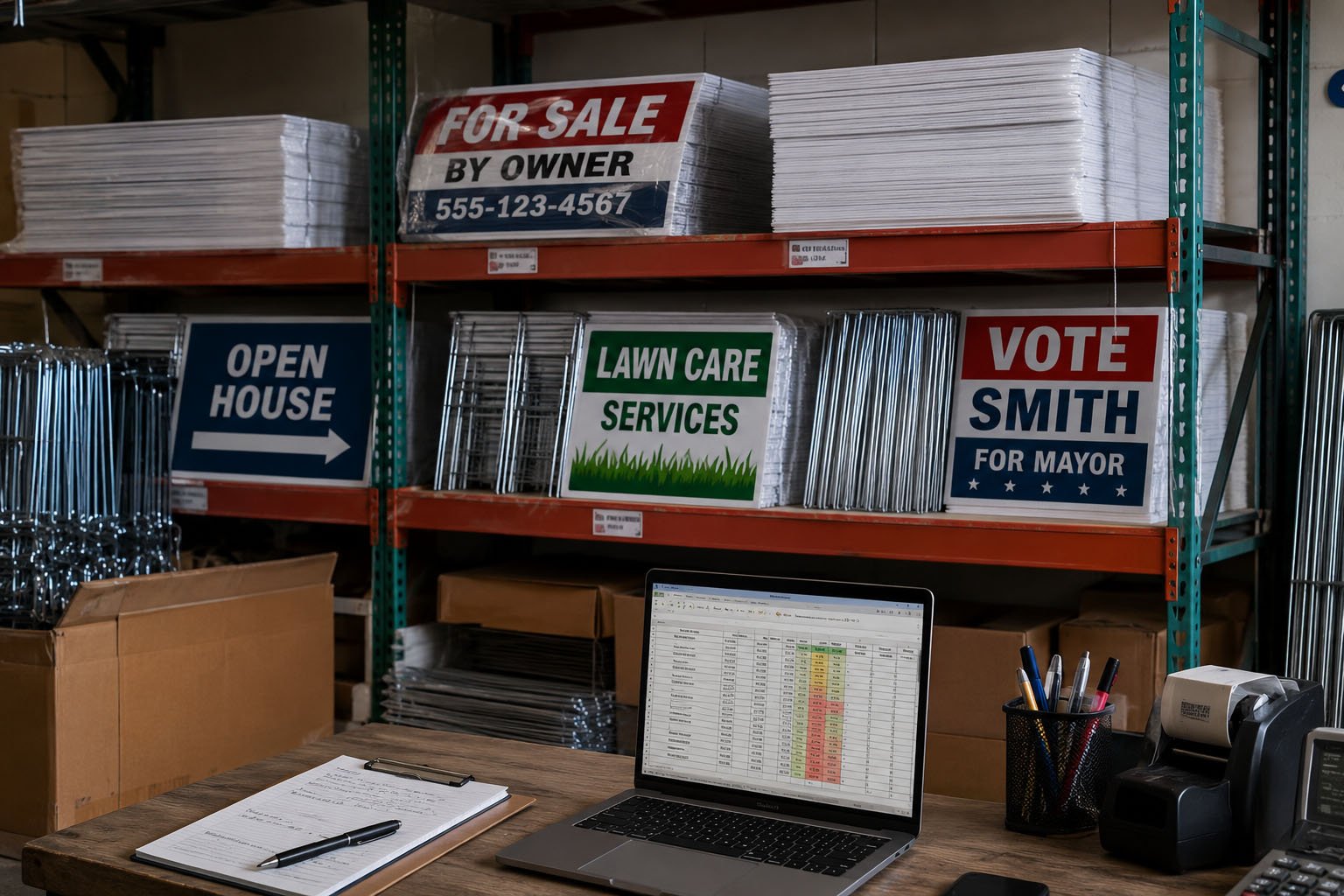
A total inventory number can hide an important problem. A seller may have 10,000 yard signs in stock, but the best-selling design may be nearly sold out while several slower designs occupy most of the warehouse.
Track inventory separately for:
- Each printed design
- Each size
- Each material thickness
- One-sided and double-sided versions
- Signs with different hole or stake configurations
- Individual packaging and bulk packaging formats
For example, a distributor may sell 18×24 real estate signs quickly but move custom event signs more slowly. These two products should not use the same reorder point simply because they are made from similar corrugated plastic.
The reorder decision should be based on the movement of each important stock-keeping unit, or SKU. If several designs share the same production specification, they may be combined in one factory order, but their sales rates should still be tracked separately.
2. Calculate the Complete Replenishment Lead Time
Many buyers calculate only the factory production time. That can create an overly optimistic inventory plan. A yard sign order is not available for sale when printing begins. It becomes available after production, packing, shipping, customs handling, and delivery are completed.
A complete lead-time estimate may include:
- Artwork review and specification confirmation
- Sample production or proof approval
- Mass production
- Counting and quality inspection
- Packaging and carton labeling
- Export preparation
- International transportation
- Customs or import processing
- Domestic delivery to the warehouse
The exact timing depends on order size, destination, shipping method, season, and whether the artwork or packaging changes. Buyers should ask for a realistic production and delivery estimate rather than using a general number from a previous order.
Before planning the reorder date, review the
bulk custom yard sign lead time guide
and confirm the expected schedule for the specific order.
3. Add Safety Stock Based on Real Risk
Safety stock is extra inventory held to reduce the chance of running out. It should not be selected randomly. The right amount depends on demand variation and supply risk.
A higher safety stock may be appropriate when:
- Sales increase sharply during a seasonal campaign
- The product is a best-selling standard design
- The buyer has strict delivery commitments
- The order is shipped internationally
- The product has several artwork versions
- The supplier or shipping schedule is less predictable
- A replacement order would take too long
A lower safety stock may be reasonable when:
- The design is experimental or slow-moving
- The product is made only after the customer places an order
- The buyer has flexible delivery dates
- Local emergency printing is available
- The seller is testing a new market
Holding too much safety stock can create its own problems, including storage cost, outdated designs, damaged packaging, and cash-flow pressure. Safety stock should protect the business from realistic variation, not cover every possible uncertainty.
4. Plan Reorders Around Seasonal Demand
Yard sign demand is rarely constant throughout the year. Real estate activity, spring and summer home services, local events, political campaigns, school activities, and holiday promotions may create short periods of higher demand.
Before a busy season, review:
- Sales from the same period in previous years
- Current customer inquiries and confirmed orders
- Planned advertising or promotional campaigns
- Customer project calendars
- Expected weather and installation conditions
- Supplier production capacity during the busy period
Do not wait until demand has already increased to place the order. International production and delivery may take longer than a local reorder, especially when several custom designs or special packaging requirements are involved.
A useful approach is to create a seasonal demand forecast and then review it with the factory before confirming the quantity. This helps the buyer decide whether to place one large order, split the order into shipments, or reserve production capacity in advance.
5. Include H-Stakes in the Inventory Plan
A common inventory mistake is to track the printed signs but not the H-stakes. A seller may have enough sign boards in the warehouse but not enough stakes to complete the customer’s order.
Track at least:
- Signs available for sale
- H-stakes available for sale
- Stakes already reserved for open orders
- Damaged or unusable stakes
- Stakes packed separately from the signs
If one sign requires one H-stake, the target quantity may appear simple. However, bulk buyers should still allow for damaged pieces, warehouse handling, samples, and replacement needs.
The quotation should state whether H-stakes are included and how they will be packed. The
yard sign and H-stake packaging guide
can help buyers organize this part of the order.
6. Separate Available Stock from Reserved Stock
Warehouse inventory is not always available inventory. Some signs may already be allocated to confirmed customer orders, retail replenishment, marketplace orders, or a scheduled campaign.
Use this basic calculation:
Available Stock = Physical Stock − Reserved Stock − Damaged Stock
The reorder decision should be based on available stock rather than the number of cartons physically present in the warehouse.
For example, a seller may have 4,000 signs on hand, but 1,500 are already reserved for confirmed orders and 200 are damaged. The actual available inventory is 2,300 signs. Using the physical count alone would delay the reorder and increase the risk of a stockout.
7. Keep Artwork Versions and Reorder Information Organized
A reorder is not only a quantity decision. It is also a file-control decision. If the wrong artwork version is sent to production, the seller may receive a large quantity of signs that cannot be sold.
Keep a reorder record containing:
- Approved artwork file name
- Artwork version or approval date
- Finished sign dimensions
- Material and thickness
- Printing sides
- Hole and stake configuration
- Packaging details
- Previous order quantity
- Customer or marketplace use
Do not assume that “same as last time” is enough when a business has several designs. A clear reorder specification reduces the risk of producing an outdated logo, old phone number, previous address, or discontinued campaign message.
For buyers managing several designs, the
multiple-design bulk order guide
can help organize artwork, quantities, and production information.
8. Decide Whether to Reorder or Change the Product
Not every low-stock product should be reordered exactly as before. Before confirming a new order, review whether the design, size, packaging, or quantity still matches current customer demand.
Ask:
- Is the design still generating repeat sales?
- Have customers requested a different size or message?
- Has the brand identity or contact information changed?
- Are customers asking for individual packaging?
- Is the current order quantity creating too much slow stock?
- Would a standard design and a custom design need different inventory strategies?
A reorder is a good opportunity to improve the product specification. For example, a seller may discover that customers prefer a shorter message, stronger contrast, or a complete sign-and-stake kit.
9. Use a Reorder Checklist Before Sending the Purchase Order
Before placing the next bulk order, confirm the following:
- Current available stock by design
- Average weekly or monthly sales
- Open customer orders and reserved stock
- Expected production and delivery lead time
- Required safety stock
- Quantity of H-stakes needed
- Correct artwork versions
- Packaging and carton requirements
- Delivery address and postal code
- Inspection and approval requirements
This checklist keeps inventory planning connected to production details. It also gives the factory a clearer purchase order and reduces unnecessary follow-up questions.
How iYardSign Can Support Planned Reorders
A factory partner can make reorders easier when the buyer maintains clear specifications and approved artwork records. iYardSign can discuss repeat production for custom corrugated plastic yard signs, H-stakes, multiple designs, packaging, and delivery requirements.
Buyers can review the
long-term yard sign supplier relationship guide
for ideas on improving communication and repeat-order consistency.
For a new reorder, send the design list, quantities, sign specifications, stake requirements, packaging details, and delivery location. This allows the factory to review the request based on the actual inventory plan rather than quoting a generic product.
You can also review the
iYardSign custom service
before preparing the next production request.
Frequently Asked Questions
What is a good reorder point for bulk custom yard signs?
There is no universal quantity. A practical reorder point depends on average sales during the complete production and delivery lead time, plus enough safety stock to cover realistic demand or shipping variation.
Should every yard sign design have the same reorder point?
Usually not. Best-selling designs, seasonal designs, and slow-moving designs have different sales rates and should be reviewed separately. They may be combined in one factory order, but their inventory thresholds should remain different.
How much safety stock should a yard sign seller keep?
The amount depends on demand changes, delivery reliability, customer commitments, and the cost of running out. A seller with strict delivery promises or long international lead times may need more safety stock than a seller with flexible delivery dates.
Should H-stakes be included in the reorder calculation?
Yes. If the product is sold as a complete sign kit, the seller should track signs and H-stakes separately and confirm that both quantities are sufficient for the next customer orders.
When should I start planning a reorder from China?
Start planning before inventory reaches the final emergency level. Review current sales, expected lead time, seasonal demand, artwork status, packaging, and delivery requirements early enough to allow time for production and international transportation.
Planning Your Next Bulk Yard Sign Reorder?
Send iYardSign your current design list, estimated quantities, sign specifications, H-stake requirements, packaging needs, and delivery location. We can review the information for a repeat-order quotation.